
Overtime is one of the most common ways Ontario employers accidentally violate the Employment Standards Act, 2000 (ESA).
Many businesses assume that paying a salary, calling someone a manager, or letting employees “volunteer” extra hours gets them off the hook. It does not.
When overtime is mishandled, employers face:
- Retroactive overtime payments going back up to two years (or more in litigation)
- Administrative penalties and Ministry of Labour orders
- Legal fees for ESA claims, grievances, or wrongful dismissal lawsuits
- Morale damage and loss of trust across the workforce
This guide walks Ontario employers through their legal obligations around overtime, how to calculate it correctly, and how to build systems that prevent small mistakes from turning into expensive disputes.
Note: This is general information based on Ontario law, not legal advice for your specific situation. Always confirm current rules on the Government of Ontario website or with an employment lawyer.
Key official resources include:
- Ontario Employment Standards Act (ESA):
https://www.ontario.ca/laws/statute/00e41 - Overtime Pay – Guide to the ESA:
https://www.ontario.ca/document/your-guide-employment-standards-act-0/overtime-pay

1. The Business Cost of Overtime Non-Compliance in Ontario
Overtime mistakes almost always come down to one of three issues:
- Misclassifying who is entitled to overtime
- Miscalculating overtime pay
- Poor record-keeping and ad hoc practices
The financial and operational costs can include:
- Large, unexpected lump-sum payouts to current and former employees
- Ministry of Labour investigations and compliance orders
- Group claims by multiple employees once one person raises an issue
- Damaged employer brand, especially in small or specialized industries
Overtime is not just a payroll issue. It is a legal compliance and risk management issue.
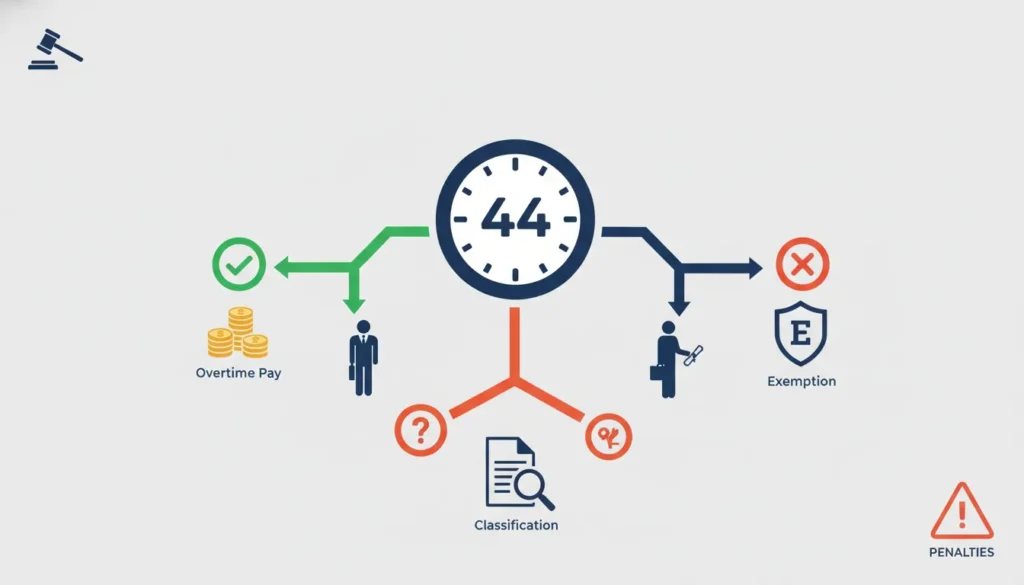
2. Understanding Ontario’s Oversight Obligations: ESA Requirements, Exemptions, And Classification Decision Tree
Under the ESA, most employees in Ontario are entitled to overtime pay:
- When they work more than 44 hours in a work week
- At a rate of at least 1.5 times their regular rate of pay for every hour over 44
Overtime is calculated by week; you generally cannot average hours over multiple weeks unless a valid ESA-approved overtime averaging agreement is in place.
See more detail here:
https://www.ontario.ca/document/your-guide-employment-standards-act-0/overtime-pay
Who Is Covered, And Who Is Exempt?
Not every worker is entitled to overtime under the ESA. Some roles and industries are fully or partially exempt. Examples include:
- Managers and supervisors, if they truly spend most of their time in managerial duties and only perform non-managerial tasks occasionally
- Certain professionals, such as lawyers, some IT professionals, and regulated health professionals in specific contexts
- Some commission-based sales roles that meet defined criteria
- Certain farm, construction, or transport workers under specific rules
The list and definitions are technical and can change. The key risk:
Many employers assume an employee is overtime-exempt because they are salaried, well-paid, or have manager in their title. That is not enough.
Classification Decision Tree: Overtime Entitlement
You can think of the decision-making process like this:
- Is this person an employee under the ESA?
- If they are a true independent contractor, ESA overtime does not apply.
- If they are a misclassified employee, overtime may be owed.
- If an employee, are they in an overtime-exempt category?
- Review ESA exemptions and special rules by job type and industry.
- Do not assume based on title or salary.
- If not exempt, what is their regular rate of pay?
- Hourly rate, or
- For salaried employees, their hourly equivalent.
- Did they work more than 44 hours in the work week?
- If yes, overtime is triggered, subject to any approved averaging arrangements or written time-in-lieu agreements.
If you cannot confidently walk through this decision tree for each role in your organization, you have classification risk.

3. Calculating Overtime Pay Correctly: Methods, Scenarios, And Pitfalls
Getting the math wrong is one of the fastest ways to create underpayment problems.
Step 1: Determine The Regular Rate Of Pay
The regular rate is the starting point for calculating the 1.5 times overtime rate.
- Hourly employees
- Regular rate = their hourly wage.
- Overtime rate = 1.5 × hourly rate.
- Salaried employees
- Regular rate = weekly salary divided by hours the salary is meant to cover.
- For example:
- Weekly salary: 1,000
- Regular work week: 40 hours
- Regular rate: 1,000 ÷ 40 = 25 per hour
- Overtime rate: 1.5 × 25 = 37.50 per hour
- Employees with multiple rates
- If an employee is paid different rates for different tasks in a week, you typically need to calculate a weighted average regular rate for that week.
- Commission or piecework employees
- There are special rules for calculating their regular rate based on total earnings and total hours in the week.
- When in doubt, get legal or payroll expert input.
Step 2: Identify Overtime Hours
In most cases:
- All hours over 44 in a work week are overtime hours
- Daily overtime is not required under the ESA (though some employers offer it contractually)
Example:
- Employee works 50 hours in a week
- 44 hours at regular rate
- 6 hours at overtime rate
Example 1: Hourly Employee
- Hourly wage: 20
- Hours worked in week: 52
Overtime hours:
- 52 − 44 = 8 overtime hours
Overtime pay:
- Overtime rate: 1.5 × 20 = 30
- Overtime pay: 8 × 30 = 240
Total weekly pay:
- Regular pay: 44 × 20 = 880
- Overtime pay: 240
- Total: 1,120
Example 2: Salaried Employee Working Overtime
- Weekly salary covers 40 hours: 1,200
- Actual hours worked: 48
Regular rate:
- 1,200 ÷ 40 = 30 per hour
Overtime hours:
- 48 − 44 = 4 overtime hours
Overtime rate and pay:
- Overtime rate: 1.5 × 30 = 45
- Overtime pay: 4 × 45 = 180
Total for the week:
- Salary: 1,200
- Additional overtime pay: 180
- Total: 1,380
A common mistake is to assume the weekly salary covers all hours worked, including overtime. For non-exempt employees, this is wrong.
Time Off In Lieu Of Overtime Pay
Ontario allows employers and employees to agree in writing to:
- Provide paid time off instead of cash overtime, at 1.5 hours of paid time off for each overtime hour worked.
This requires:
- A clear written agreement
- Proper tracking of banked time
- Providing the time off within the required timeframe (or paying it out if the employment ends)
You cannot simply tell staff to take time off later without satisfying these requirements.
Common Overtime Calculation Pitfalls
Watch out for:
- Averaging hours over multiple weeks without a proper averaging agreement approved as required
- Failing to include non-discretionary bonuses or premiums when calculating the regular rate
- Misapplying daily overtime rules from another jurisdiction (for example, copying a US policy and using it in Ontario)
- Letting employees “volunteer” off-the-clock work or answer emails after hours without tracking time
If employees are performing work, including after-hours remote work, those hours may be compensable.

4. Building Proactive Compliance Systems: Audits, Records, And Risk Management
Overtime compliance is not about reacting to complaints; it is about building systems that reduce the chance of non-compliance in the first place.
Internal Overtime Compliance Audit
A simple internal audit can significantly reduce risk. Key steps:
- Review all roles and decide:
- Is this role exempt from overtime under the ESA?
- If so, why? Document the rationale.
- Confirm that for non-exempt roles:
- Hours are accurately tracked each week
- Regular rates and overtime rates are correctly set in your payroll system
- Time off in lieu is only used with clear written agreements
Record-Keeping Obligations
The ESA requires employers to keep specific records, including:
- Hours worked each day and each week for most employees
- Wage rates and changes to wage rates
- Vacation pay, public holiday pay, and overtime records
These records must be retained for a minimum period (commonly three years) after the work is performed or the employee’s employment ends.
A simple visual checklist:
| Area | What To Track | Why It Matters |
|---|---|---|
| Hours worked | Daily and weekly hours for each employee | Proves whether overtime is owed |
| Wage and overtime rates | Base rate, overtime rate, changes over time | Supports correct calculations |
| Overtime agreements | Time-in-lieu agreements, averaging agreements | Shows any special arrangements are valid |
| Payments and banked time | Overtime amounts paid or banked, balance status | Prepares you for audits or disputes |
| Policies and training | Policy versions, training dates, attendance | Demonstrates due diligence |
Well-kept records are your best defence if a dispute arises.
Policy, Culture, And Manager Training
A compliant overtime policy should:
- Clearly state when overtime is authorized and how
- Confirm that all overtime worked by non-exempt employees will be paid, even if it was not pre-approved
- Specify consequences for working unauthorized overtime while still making clear it will be paid
Supervisors and managers should be trained to:
- Understand which roles are overtime-eligible
- Monitor and approve time accurately
- Avoid informal arrangements that conflict with the ESA
If front-line managers are telling employees to work off the clock, your written policy will not protect you.

5. Managing Overtime Disputes And Strategic Resolution
Even with good systems, disputes can arise. How you respond can dramatically change the outcome and cost.
First Response: Listen, Review, And Correct If Needed
When an employee raises a concern about unpaid overtime:
- Take it seriously, even if it seems minor
- Review their hours, pay records, and classification
- Compare your practices to ESA requirements
If you identify an underpayment:
- Correct it promptly
- Consider whether other employees were affected
- Adjust your processes to prevent recurrence
Voluntary, timely correction can sometimes prevent escalation to formal complaints.
Ministry Of Labour Claims
Employees can file a claim with the Ministry of Labour if they believe they have not been paid proper overtime.
If you receive notice of a claim:
- Gather relevant records immediately
- Provide accurate information to the investigator
- Consider engaging an employment lawyer where the claim is large, complex, or may set a precedent for your business
The Ministry can order payment of:
- Unpaid overtime
- Vacation or public holiday pay linked to unpaid wages
- Administrative penalties
They may also audit beyond the individual complaint if broader issues are suspected.
Litigation And Cost-Benefit Analysis
Some overtime disputes move beyond ESA claims into:
- Wrongful dismissal lawsuits that also seek unpaid overtime
- Class or group claims by multiple employees or former employees
Before taking a hard line, weigh:
- The cost of settlement versus prolonged litigation
- The risk of other employees coming forward
- Reputational and morale impacts
A strategic resolution often combines:
- Correcting past underpayments
- Updating classification and payroll practices
- Communicating changes to staff to rebuild trust
Workforce Planning Alternatives To Constant Overtime
Sometimes chronic overtime is a symptom of a deeper planning issue. Consider:
- Hiring part-time or casual staff to handle peaks
- Cross-training employees to spread workload more evenly
- Implementing scheduling tools that track overtime before it happens
- Reviewing whether workload expectations are realistic for the staffing level
Reducing unnecessary overtime can:
- Reduce legal risk
- Improve employee well-being
- Make your total labour cost more predictable
Legal Disclaimer
The information in this article is provided for general informational purposes only and is not legal advice. No content here shall be interpreted as implying that Dimitrov Law Professional Corporation or Atanas Dimitrov are the best or superior to any other lawyers or law firms. For guidance related to your specific situation, please consult a qualified professional.
Call to Action
Message us here with any questions OR visit our website: https://dl-pc.ca/.