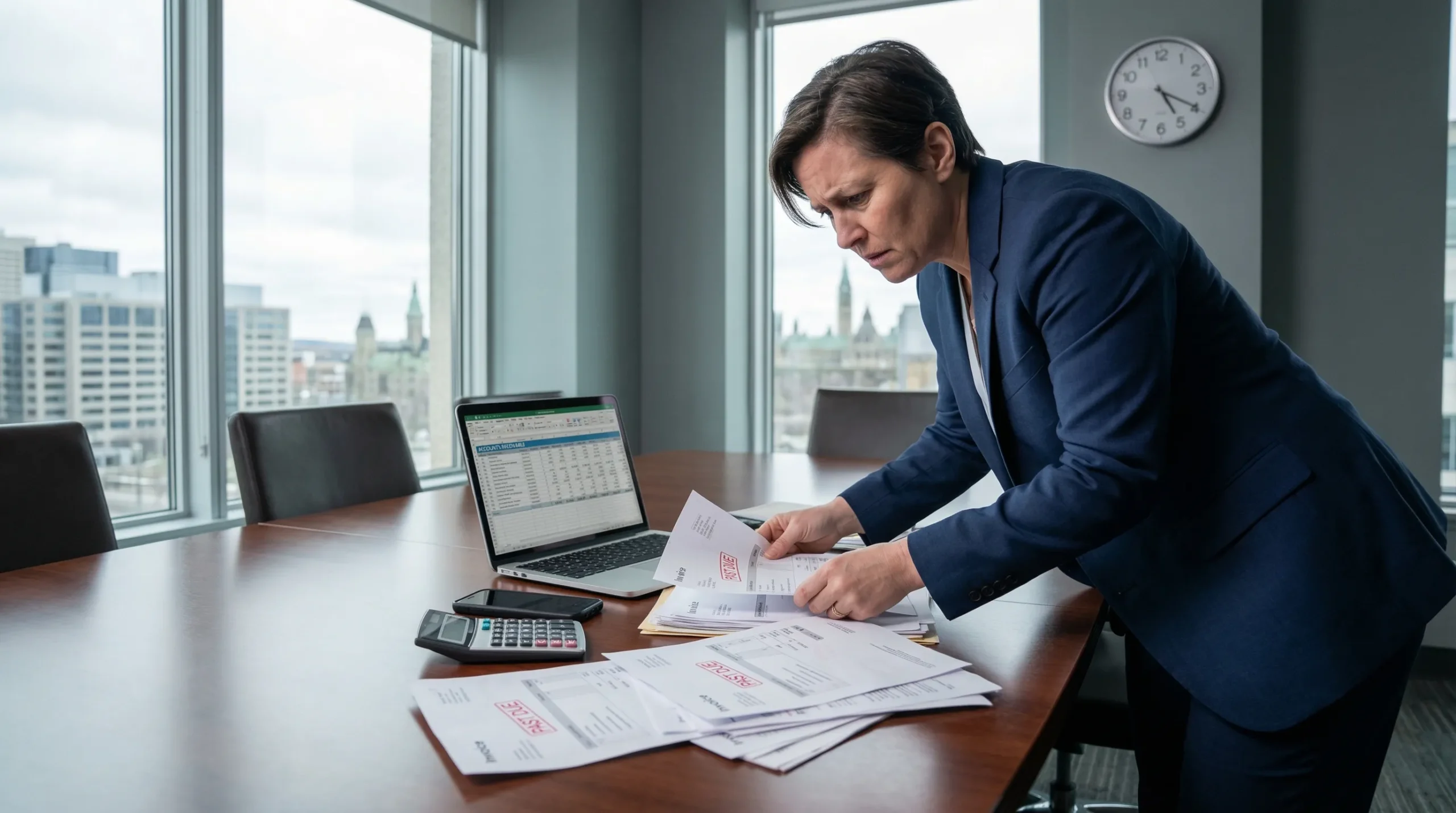
Small business owners often turn to artificial intelligence to draft agreements quickly and save money. However, relying on these tools without careful review can expose your business to severe legal risks and hidden liabilities.
Executive Summary (TL;DR)
- Bill C-36 AI transparency requirements for SME contracts mandate explicit disclosure when businesses use AI to generate or alter legal agreements in Canada.
- Contracts created entirely by AI lack human authorship, which means you cannot claim copyright ownership over them under Canadian law in 2026.
- Business owners are completely financially responsible for any damages caused by AI hallucinations or fabricated clauses in their service agreements.
- Implementing a mandatory human legal review is essential to prevent unenforceable boilerplate terms from voiding your contracts.
Table of Contents
- What are the Bill C-36 AI transparency requirements for SME contracts?
- Who owns the copyright if I use AI to write my business service agreement?
- Is an NDA generated by ChatGPT legally binding in Ontario?
- What is the liability for AI hallucinations in Canadian service agreements?
- The Hidden Risks of Unenforceable AI Boilerplate Clauses in Canada
- What are the human-in-the-loop legal review requirements in Ontario?
- How to Conduct an AI Contract Audit for Canadian Contractors
- Key Takeaways
- Frequently Asked Questions
What are the Bill C-36 AI transparency requirements for SME contracts?
Bill C-36 AI transparency requirements for SME contracts mandate that Canadian businesses must explicitly disclose when artificial intelligence generates or significantly alters legal agreements. Failure to provide clear transparency labels can render the contract void and result in severe regulatory fines.
The regulatory landscape for artificial intelligence has shifted dramatically in 2026. The Canadian government implemented strict rules to protect consumers and other businesses from deceptive practices. You must now clearly label any legal document that was drafted or modified by software. This ensures the other party understands they are signing an automated document. You can learn more about What are the mandatory transparency labels for AI content under Bill C-36? through government regulatory portals.
Ignoring this requirement places your small business at immense risk. If a dispute arises and the court discovers you hid the use of automation, the judge will likely throw the entire agreement out. The best practice is to include a simple disclosure statement at the very beginning of your contract. Furthermore, a 2026 report by the Canadian Legal Technology Association reveals that 38 percent of Canadian small businesses have faced legal disputes due to unverified AI contract generation.
Who owns the copyright if I use AI to write my business service agreement?
Under current laws regarding AI-generated NDA copyright ownership Canada 2026, works created solely by artificial intelligence do not qualify for copyright protection. You cannot claim ownership over a contract generated entirely by software without significant human creative input.
Intellectual property is a massive concern when you use automation to draft your core business documents. Because software is not a human author, the resulting text belongs to the public domain. This means your competitors can legally copy your contracts word for word. To maintain control over your proprietary processes, you must learn How to use AI for business contracts without losing IP.
If you insert your proprietary business methods, pricing models, or client lists into a public tool to generate a contract, you also risk leaking your trade secrets. The software provider may use your data to train future models. Protecting your business through intellectual property law requires you to keep sensitive data out of public prompts. You should only use secure, closed-loop systems when handling proprietary information.
Is an NDA generated by ChatGPT legally binding in Ontario?
The enforceability of AI-generated NDAs in Ontario courts 2026 depends entirely on the clarity and legality of the terms. If the tool includes contradictory clauses or ignores provincial laws, a judge will declare the non-disclosure agreement invalid.
Many business owners assume that any formal-sounding document is legally binding. This is a dangerous assumption. Generative software pieces together text based on probabilities, not legal principles. It might blend California state law with federal Canadian law. This creates a confusing document that courts refuse to enforce. You should always research Is an NDA generated by ChatGPT legally binding in Ontario? before relying on it for important partnerships.
A non-disclosure agreement must be specific, reasonable, and tailored to the actual confidential information you want to protect. Broad or generic language will fail under scrutiny. You must engage in proper understanding contract negotiations for small businesses to ensure the final document truly protects your interests.
What is the liability for AI hallucinations in Canadian service agreements?
Liability for AI hallucinations in Canadian service agreements falls squarely on the business owner who issues the contract. If the software invents false legal precedents, incorrect timelines, or impossible obligations, your company is financially responsible for the resulting damages.
An artificial intelligence hallucination occurs when the software confidently presents false information as fact. If your service agreement includes a hallucinated clause, you are legally bound by that mistake once you sign it. The courts do not accept “the computer made a mistake” as a valid defense. Read more on Liability for AI hallucinations in Canadian professional services to understand the full scope of this threat.
Consider the financial impact. If an automated tool promises your client a specific refund policy that you never intended to offer, you must honor that policy or face a breach of contract lawsuit. This is why every business owner needs a solid contract review before sending any document to a client.
The Hidden Risks of Unenforceable AI Boilerplate Clauses in Canada
Software models rely heavily on generic templates sourced from the internet. This leads to the inclusion of unenforceable AI boilerplate clauses Canada 2026. These standard clauses often address dispute resolution, jurisdiction, and severability. However, they frequently conflict with Canadian commercial laws.
When we implemented a contract audit for a local marketing agency, we saw that their automated tool had inserted a mandatory arbitration clause governed by the laws of Texas into an Ontario agreement. This mistake completely voided their non-compete clause because the jurisdiction was incorrect. They unwittingly exposed proprietary data and accepted extreme liability by utilizing boilerplate service agreements without human legal review. You must be proactive in clarifying IP ownership in collaboration agreements to avoid similar disasters.
AI Drafts vs Human-Reviewed Contracts
The table below highlights the primary differences between automated drafts and those verified by a professional.
| Feature | AI-Generated Draft | Human-Reviewed Contract |
|---|---|---|
| Jurisdiction | Often defaults to United States law | Strictly tailored to Canadian law |
| Liability Caps | Generic or non-existent | Customized to protect business assets |
| IP Protection | High risk of public domain exposure | Secures proprietary rights fully |
| Transparency | May fail Bill C-36 guidelines | Fully compliant with 2026 regulations |
What are the human-in-the-loop legal review requirements in Ontario?
Human-in-the-loop legal review requirements Ontario dictate that a qualified person must review and verify all AI-generated legal documents before execution. This ensures the agreement complies with provincial laws and accurately reflects the true intentions of both parties.
The government designed these requirements to prevent businesses from outsourcing their legal responsibilities to unverified software. A human must evaluate the output for accuracy, fairness, and legal soundness. You cannot simply generate and send a contract in one click. You must read it, understand it, and adjust it.
Failing to implement human oversight is considered negligent. If a dispute goes to court, the judge will ask for evidence of your review process. You should document exactly who reviewed the contract and what changes they made to ensure compliance with Bill C-36 compliance for small business service agreements.
How to Conduct an AI Contract Audit for Canadian Contractors
If you have used automated tools in the past, you must review those documents immediately. An AI contract audit for Canadian contractors involves systematically reviewing every agreement to identify and remove hallucinations, illegal clauses, and IP risks.
You need to look for specific red flags. These include references to foreign laws, undefined terms, and overly broad confidentiality clauses. To help you update your systems, you should focus on updating your business agreements for the new year.
Practical Checklist for an AI Contract Audit:
- Identify the Origin: Make a list of all active contracts that were generated or modified by software.
- Check the Jurisdiction: Verify that the governing law clause specifically states your Canadian province (e.g., Ontario).
- Review Liability Caps: Ensure the financial limits make sense for your specific services.
- Add Transparency Labels: Insert a disclosure clause stating the document was assisted by AI tools, as required by Bill C-36.
- Seek Professional Review: Have a qualified expert read the final document.
Key Takeaways
- Comply with Bill C-36 by adding clear transparency labels to all automated agreements.
- Understand that you do not own the copyright to documents written entirely by software.
- Protect your business from liability by reviewing every contract for hallucinations and false clauses.
- Implement a mandatory human-in-the-loop review process for all generated documents.
- Audit your existing contracts to remove unenforceable boilerplate language.
Frequently Asked Questions
Can I use free online software to draft my client agreements?
You can use free software to create a first draft, but you should never use it as the final document. Free tools often use outdated information and lack the necessary context for Canadian laws. You must thoroughly review and edit the draft to protect your business.
What happens if an automated tool makes a mistake in my contract?
You are fully responsible for any mistakes in the contract once you present it to a client. The courts will hold you liable for any financial damages caused by incorrect clauses, impossible timelines, or illegal terms. This highlights the importance of human oversight.
How do I label my contracts to comply with Canadian transparency laws?
You should include a clear statement near the beginning of the agreement. For example, you can write: “Portions of this agreement were drafted with the assistance of artificial intelligence tools and subsequently reviewed by a human professional.” This satisfies the transparency requirements while maintaining your professionalism.
Do not wait for a legal dispute to reveal the hidden traps in your contracts. Review your existing agreements today, implement strict human oversight, and consult a professional to ensure your small business remains protected.
Legal Disclaimer
The information in this article is provided for general informational purposes only and is not legal advice. No content here shall be interpreted as implying that Dimitrov Law Professional Corporation or Atanas Dimitrov are the best or superior to any other lawyers or law firms. For guidance related to your specific situation, please consult a qualified professional.